Showing posts with label Perennial. Show all posts

2010/10/12

A Journal of the Plague Year: Being Observations or Memorials of the Most Remarkable Occurrences, As Well Public As Private, Which Happened in London During ... Large Print Perennial Bestsellers Series)


Available at Amazon Check Price Now!


A Journal of the Plague Year: Being Observations or Memorials of the Most Remarkable Occurrences, As Well Public As Private, Which Happened in London During ... Large Print Perennial Bestsellers Series)


   Customer Rating :


   Availibility : N/A


A Journal of the Plague Year: Being Observations or Memorials of the Most Remarkable Occurrences, As Well Public As Private, Which Happened in London During ... Large Print Perennial Bestsellers Series) Overviews


In 1665, the Great Plague swept through London, claiming nearly 100,000 lives. In A Journal of the Plague Year, Defoe vividly chronicles the progress of the epidemic. We follow his fictional narrator through a city transformed-the streets and alleyways deserted, the houses of death with crosses daubed on their doors, the dead-carts on their way to the pits-and encounter the horrified citizens of the city, as fear, isolation, and hysteria take hold. The shocking immediacy of Defoe's description of plague-racked London makes this one of the most convincing accounts of the Great Plague ever written.


A Journal of the Plague Year: Being Observations or Memorials of the Most Remarkable Occurrences, As Well Public As Private, Which Happened in London During ... Large Print Perennial Bestsellers Series) RelateItems


A Journal of the Plague Year: Being Observations or Memorials of the Most Remarkable Occurrences, As Well Public As Private, Which Happened in London During ... Large Print Perennial Bestsellers Series) CustomerReview


Thanks to 20th century medical and public health advances, we now know how to prevent, stem, and treat most infectious diseases. Though a few folks may still recall the flu epidemic of 1918, which cost 20 millions lives worldwide and a half million in the United States alone, for most of us living outside the Third World, fear of epidemic has become largely a thing of the past.

But if you wish to glimpse daily life under the threat of impending death by disease (without actually being threatened by it), along with the accompanying grief, despair, depravity, kindness, and courage, Daniel Defoe's "A Journal of the Plague Year" can take you there.

However, Defoe`s classic work is neither a journal nor of the plague year. Rather, it consists of an odd and hardly chronological collection of anecdotes, statistics, and ruminations written by the author of Moll Flanders some fifty years after the Plague of 1665 (when he was but a child of four). While pretending to be a first person eyewitness account of the epidemic, the Journal is in fact convincingly realistic fiction. The author has wisely created a narrator and a literary vehicle that powerfully portrays 17th century London and the agonies of an epidemic that killed more than 100,000 in the city.

Early on, Defoe establishes credibility for his fictional construct by quoting detailed figures (seemingly culled from official documents) on the growing death tolls as the Black Death spread across London. Further, throughout the book he documents the legal measures, such as quarantining households, and describes the medical endeavors to fight the disease and its spread. But more important, having once persuaded the reader of the authenticity of his tale, Defoe gets under the skin of the plague by showing the human suffering and drama it created.

He accomplishes this through his fictional narrator, a bachelor merchant who saunters about London hearing cries of pain, listening to tales of death, observing grief-deranged survivors roaming the streets, and even visiting the mass graves where, under the cover of night, death carts dump their grisly loads.

Also, we are privy to the deliberations of our moralistic but pragmatic narrator--on whether or not to flee London with his brother's family, on predestination and free will, on the quackery and skullduggery that fed on fear and ignorance. This imaginative character's active, intelligent, and detailed surveillance of the epidemic places us in the streets of London and creates a work of lasting vitality.

Through him we see the people's susceptibility to omens, religious superstition, prophets of doom, and astrologers; to quacks, charlatans, and fortune-tellers. We glimpse the duplicity and cowardice of the government and ruling class, who frequently fled London to save their own skins while abandoning their servants to penury and possible infection. We view mountebanks fleecing desperate families, nurses murdering and robbing their lingering patients, and the sick taking their own lives to save themselves a last few hours of pain. But we also are shown acts of great kindness, courage, charity, and love, as well as human ingenuity in service of a will to survive in the face of seeming doom.

Ultimately, the book is perhaps not so much about the plague as about human nature, of which Defoe is a keen observer, showing us that 17th century Londoners are not much different from ourselves. .

But as gloomy as this subject matter may seem, he can present it with a light and often-humorous touch, as in his story of the drunken piper. The beggar had passed out on the street after given an uncustomarily large amount to drink. A second man, thinking the piper a corpse, laid a plague victim beside him for the death cart to retrieve. The piper did not revive until about to pushed into a mass grave. He called out, "Where am I?" The sexton replied, "Why you are in the dead-cart, and we are going to bury you." The piper then asked, "But I ain't dead though, am I?"

Defoe presents the enigmatic narrator as both deeply affected by the suffering and aloof. He roams about London and its environs with seemingly little concern for his own well-being, at times viewing the horrific scenes with passion and compassion, and at other moments from a distant, Archimedean point of intellectual detachment. Along the way we get the narrator's (and, we suspect, the author's) views on religion, criminal justice, public health measures, medicine, government, and economics.

The pragmatism of Defoe's narrator shows through in his discussion of the last. Virtually all commerce came to a halt in the months when the plague ruled. Ships did not dock, shops closed, construction stopped, and economic life was put on hold while death profited. Defoe shows us the repercussions of this economic death--not only the hardship, the admirable efforts of certain government officials to help the needy, and the charity of many--but also how it helped stem the spread of the disease by reducing contact among people.

In the end, it's Defoe's details that win out, making this fictional account read as the intimate first-person portrayal it purports to be: the 200,000 pet dogs and cats rounded up and slaughtered to help prevent the epidemic's spread; the infection and quick death of infants who fed at the breasts of their diseased mothers; the public whippings of those who stole from the dead; the excruciating pain of the swellings brought on by the bubonic plague and the perhaps even more painful attempts by physicians to break the tumors with hot irons. Such details as these, perhaps too realistically rendered for the squeamish, give "A Journal of the Plague Year" an irresistible authority.

However, the whole conceit might have fallen flat had it not been crafted with such a deft, and I think, sly, touch. Defoe's language never flies toward hyperbole, but is grounded in seemingly careful observation--even when the narrator is deeply moved. Defoe's slyness is evident in his narrator often claiming faulty memory or lack of knowledge--"whether he lived or died I don't remember"--which augments the verisimilitude of his highly creative and still haunting work.


*** Product Information and Prices Stored:Oct 12, 2010 20:01:30

Available at Amazon Check Price Now!

Bicycle Trailer Store Lacoste Polo Shirt Sale Bagless Vacuum Cleaner

2010/09/14

The Bridge of San Luis Rey (Perennial Bestseller Collection)


Available at Amazon Check Price Now!


The Bridge of San Luis Rey (Perennial Bestseller Collection)


   Customer Rating :


   Availibility : Usually ships in 1-2 business days


The Bridge of San Luis Rey (Perennial Bestseller Collection) Overviews


This beautiful new edition features unpublished notes for the novel and other illuminating documentary mate- rial, all of which is included in a new Afterword by Tappan Wilder.

"On Friday noon, July the twentieth, 1714,the finest bridge in all Peru broke and precipi-tated five travelers into the gulf below." With this celebrated sentence Thornton Wilder begins The Bridge of San Luis Rey, one of the towering achievements in American fiction and a novel read throughout the world.

By chance, a monk witnesses the tragedy. Brother Juniper then embarks on a quest to prove that it was divine intervention rather than chance that led to the deaths of those who perished in the tragedy. His search leads to his own death -- and to the author's timeless investigation into the nature of love and the meaning of the human condition.


The Bridge of San Luis Rey (Perennial Bestseller Collection) RelateItems


The Bridge of San Luis Rey (Perennial Bestseller Collection) CustomerReview


The book "The Bridge of San Louis Rey" plagues you with the question, "Why those five?" The book then goes into a small segment of the personal lives of all the victims of the bridge collapse, ultimately leaving it up to you to decide and think about. The book was extremely well written, with careful attention to vocabulary, and sentence formation. Therefore, I give the book a 4 out of 5. All that being said, I personally did not like the book, it's just not the genre that i like to spend my time reading.


*** Product Information and Prices Stored:Sep 14, 2010 11:10:37

Available at Amazon Check Price Now!

Sale Bagless Vacuum Cleaner Vinyl Tablecloth http://peg-perego-stroller-online.blogspot.com/

2010/09/07

Northern Farm: A Glorious Year on a Small Maine Farm (Thorndike Press Large Print Perennial Bestsellers Series)


Available at Amazon Check Price Now!


Northern Farm: A Glorious Year on a Small Maine Farm (Thorndike Press Large Print Perennial Bestsellers Series)


   Customer Rating :


   Availibility : N/A


Northern Farm: A Glorious Year on a Small Maine Farm (Thorndike Press Large Print Perennial Bestsellers Series) RelateItems


Northern Farm: A Glorious Year on a Small Maine Farm (Thorndike Press Large Print Perennial Bestsellers Series) CustomerReview


Henry Beston is best known for writing about his solo Cape Cod beach experience in "The Outermost House." A few years later he married author Elizabeth Coatsworth, and they bought a farm in Maine. First published in 1948, "Northern Farm" recounts a calendar year's worth of rural life in that northern clime. Brrrr.

The chronological narrative begins as the Bestons return to their snow-covered fields and ice-capped pond after celebrating the Christmas season with friends in New York. Each chapter combines factual events with entries from Beston's farm diary, plus his summary philosophical statements. And boy, does winter sure seem to last a long time! It frames the progression of the book. Thankfully Beston takes the opportunity to describe the wildlife he's able to encounter between snowstorms. An overwhelming sense of community surfaces here as well. Remember: this story takes place in a farming landscape just after WWII, before a television could be found in every living room, and when people relied on each other for help during challenging times. They were the kind of times when you left a lantern burning in the front room so that you could more easily find your way home after attending a church supper on a rainy night. "The good old days," for some.

In addition to his notes about managing a small farm and following Nature's course, Beston ruminates about international issues. The war is still fresh in his mind, and he needs to speak about it. Read in post-9/11 times, his comments strike an eerie chord of familiarity. For example:

"No age in history can afford to lay too much emphasis upon 'security.' The truth is from our first breath to our last we inhabit insecurely a world which must of transitory nature be insecure, and that moreover any security we do achieve is but a kind of an illusion. While admitting that a profound instinct towards such safety as we can achieve is part of our animal being, let us also confess that the challenge involved in mere existence is the source of many of the greater virtues of human character." (page 47, in my paperback copy)

Wow! And that's just one of his astute observations.

"Northern Farm" describes a simpler time and place that we'll never see again, regretfully. This is a book well worth tracking down. Just be prepared for A LOT of winter!


*** Product Information and Prices Stored:Sep 07, 2010 15:40:19

Available at Amazon Check Price Now!

Proxima Projector Lacoste Polo Shirt LG LCD HDTV

2010/08/28

Cannery Row (Thorndike Press Large Print Perennial Bestsellers Series)


Available at Amazon Check Price Now!


Cannery Row (Thorndike Press Large Print Perennial Bestsellers Series)


   Customer Rating :


   Availibility : N/A


Cannery Row (Thorndike Press Large Print Perennial Bestsellers Series) Overviews


Adventures of cannery workers living in the run-down waterfront section of Monterey, California.


Cannery Row (Thorndike Press Large Print Perennial Bestsellers Series) RelateItems


Cannery Row (Thorndike Press Large Print Perennial Bestsellers Series) CustomerReview


Cannery Row is not Moby Dick or The Great Gatsby. That is, it's not a contender for `the great American novel'. But it is _a_ great American novel. Perhaps the great American anti-novel, for its loosey goosey structure, its whimsical shifting of tone and style, are likely to drive batty anyone who has a very rigid vision of what a novel must be.

This novel follows a long summer-fall season amongst those who lived in Cannery Row, Monterey, during the 1930s but who were not part of the business of canning sardines. That industry permeates their lives -- an endless supply of fish heads for cats, customers for the local businesses, etc. -- but the characters are not part of that industry or any other industry for that matter. They are all marginal to the rest of the world, from the Chinese store owner whose conversations with other people seem limited to discussions of the availability of credit to a male gopher who is conflicted because his paradise home is out of the flow of female gophers, which means he never gets laid. (I'm not making this up.)

The two most main characters, if they can be called that, are Mack and Doc. Mack is `one of the boys' at the Palace Flophouse. You'd call him chronically unemployed -- if the idea of being employed ever occurred to him. The boys individually and collectively don't seem to be playing with a full deck of cards but they live life so grandly and so philosophically that they are wiser than almost any other character or characters in fiction. (Many times, we're told a character is wise but the author can't back it up because they themselves haven't acquired that much wisdom.) Doc, whom I very affectionately envision as a younger version of the Doc in the HBO series Deadwood, is generous and compassionate -- yet lonely -- and the moral center of Cannery Row. [Deadwood with hindsight now looks like an ultraviolent and uncouth version of Cannery Row.] He runs a lab in which he catches animals, mainly from the tidal pools, to sell to schools and universities.

The other reviews note that this novel covers a range of emotions, from tragic deaths (off-stage) to the comic. The humor, however, is more salient: P. G. Wodehouse would have given his right arm to have written this. Many events that most people would cast in a tragic light are played lightly: even when depressed the characters are somehow irrepressible.

Much of the book, in fact, borders on slapstick. A major storyline involves the boys of the Palace Flophouse going on a field trip to catch frogs (to sell to Doc to fund a party for him, which seems perfectly reasonable on Cannery Row). I only have time to read these days when my newborn son is sleeping across my chest and I have to say he didn't particularly care for the frog trip because my continual laughing made his bed a little unstable. To give a flavor: the boys decide that in a trip to the country, the country would provide food, so they only bring salt and pepper. The description of gathering the other ingredients in their stew begins with reference to a rooster that wandered away from a farmhouse they're driving by (in a Model T whose acquisition and maintenance are stories in themselves). The meal begins to take shape: "Eddie hit him [the rooster] without running too far off the road." When Hazel, whose mother was undaunted in her choice of names despite the gender of her progeny, cooks him but warns the others, "He ain't going to be what you call tender."


I would in fact mull over whether this novel sentimentalizes poverty except for two things. First, the book is so extensively based on real life that it barely deserves the label fiction. (There's another book out there called Real Life on Cannery Row. I'm reading it now: one of the most interesting points is that the various buildings really were adjacent to each other and only occupied a small portion of Cannery Row.) Second, the day before I started reading this I spoke with a friend from years past who is larger than life in a Mack kind of way: if he had a ,000 a year job, he'd be so afraid of being corrupted by it that he'd give half away to friends and then convert paychecks into beer until he hit the poverty line. Then he could relax again. So there are people like Mack out there.

On the whole, the novel is able to maintain a balance between the sadness and the joy. Indeed, it does so in such a way that it is one of the few novels in which you could learn something about life.

A lot of authors from the 1920s to the 1940s come across through their characters as perpetually inebriated. Reading Fitzgerald is has a kind of boozy but truthful sadness; Hemingway is like a permanent hangover. Cannery Row and its sequel Sweet Thursday are like perfectly hitting the right point of tipsiness: there's a gloriousness to it, the feeling of being part of a happy conspiracy of everyone drinking at that moment but knowing that come morning all you'll feel are pleasant memories.


*** Product Information and Prices Stored:Aug 28, 2010 16:30:23

Available at Amazon Check Price Now!

Panasonic VIERA Hdtv Lacoste Polo Shirt George Foreman Grill

2010/04/29

White Fang (G.K. Hall Large Print Perennial Bestseller Collection)


Available at Amazon Check Price Now!


White Fang (G.K. Hall Large Print Perennial Bestseller Collection)


   Customer Rating :


   Availibility : N/A


White Fang (G.K. Hall Large Print Perennial Bestseller Collection) Overviews


The adventures in the northern wilderness of a dog who is part wolf and who eventually makes his peace with man.


White Fang (G.K. Hall Large Print Perennial Bestseller Collection) RelateItems


White Fang (G.K. Hall Large Print Perennial Bestseller Collection) CustomerReview


Jack London's turn-of-the-century novel about a wild animal (3/4 wolf) proves an odyssey of the canine heart, as the author examines
the millennium-old relationship between Man and Wolf. The story of the gradual domestication of the species proves intriguing in its psychological stages; readers are drawn into the lamentable situations endured by a creature born and partly raised in the Alaskan wilderness. Captivated by Kiche's struggle to survive famine and pack dynamics we come to realize that the story is not even about Her, but her progeny, for one pup is singled out for greatness--both excessive torment and personal growth.

At the age of five months the pup surrenders his freedom to
an Indian whom he regards as a man-god, Gray Beaver, who names him "White Fang" because of obvious reasons. The young wolf-dog's entire life consists of unremitting and undeserved torment--from dogs and humans--causing him to mature into a morose and vicious loner. Able to adapt to a variety of harsh conditions he possesses the will to survive, for he quickly grasps the various Laws: of the Wild, of the Indian Camp, and of the Pack. A victim of man's bestiality he seems doomed to a life of bleak hatred, until rescued from a miserable existence as brutal, side show entertainment by an enlightened man from the Lower Forty, Weedon Scott.

With patience and insight Scott gradually earns his trust, then
proceeds to tame the intelligent wolf-dog whom he sets free, but White Fang amazingly accepts the invisible bonds of friendship; he acknowledges Scott as more than his master: he surrenders his
freedom and fierce spirit to his new love-god. White Fang overcomes
long-ingrained habits and conditioned responses to offer his life and his heart in the form of ultimate adoration.

Impending separation looms to destroy the devoted animal, but how could a creature bred in the Wilds survive the even harsher laws of
California civilization? Unlike London's CALL OF THE WILD, where a tame dog sloughs off generations of domestication, WHITE FANG depicts a wild protagonist who completes the metamorphosis from wolf to Blessed Wolf. Great literary fare for adults and kids of all ages!


*** Product Information and Prices Stored:Apr 29, 2010 21:30:17

Available at Amazon Check Price Now!

Batik Sarong Women Best Buy PS3 Bicycle Trailer Store

2010/04/08

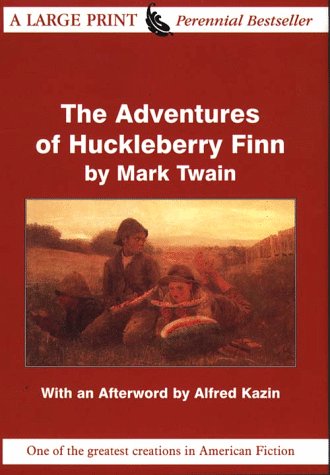
The Adventures of Huckleberry Finn (G.K. Hall Large Print Perennial Bestseller Collection)


Available at Amazon Check Price Now!


The Adventures of Huckleberry Finn (G.K. Hall Large Print Perennial Bestseller Collection)


   Customer Rating :


   Availibility : N/A


The Adventures of Huckleberry Finn (G.K. Hall Large Print Perennial Bestseller Collection) Overviews


The adventures of a boy and a runaway slave as they travel down the Mississippi River on a raft.


The Adventures of Huckleberry Finn (G.K. Hall Large Print Perennial Bestseller Collection) RelateItems


The Adventures of Huckleberry Finn (G.K. Hall Large Print Perennial Bestseller Collection) Specifications


Mark Twain's classic novel, The Adventures of Huckleberry Finn, tells the story of a teenaged misfit who finds himself floating on a raft down the Mississippi River with an escaping slave, Jim. In the course of their perilous journey, Huck and Jim meet adventure, danger, and a cast of characters who are sometimes menacing and often hilarious.

Though some of the situations in Huckleberry Finn are funny in themselves (the cockeyed Shakespeare production in Chapter 21 leaps instantly to mind), this book's humor is found mostly in Huck's unique worldview and his way of expressing himself. Describing his brief sojourn with the Widow Douglas after she adopts him, Huck says: "After supper she got out her book and learned me about Moses and the Bulrushers, and I was in a sweat to find out all about him; but by and by she let it out that Moses had been dead a considerable long time; so then I didn't care no more about him, because I don't take no stock in dead people." Underlying Twain's good humor is a dark subcurrent of Antebellum cruelty and injustice that makes The Adventures of Huckleberry Finn a frequently funny book with a serious message.


The Adventures of Huckleberry Finn (G.K. Hall Large Print Perennial Bestseller Collection) CustomerReview


Huckleberry Finn is one of those classic books that you just can't put down. It is a very good book that is suspenseful and really draws you in. It starts off with Huck imprisoned in civilization surrounded with good manners and sophistication. Daily he goofs off with his pals Tom Sawyer and others, imagining up scenarios where there is plenty of action and fun to be had. When his father returns, Huck has to stay with him but soon escapes, faking his own death and running away to a local island to live on his own. There, he meets Jim, Miss Watson's slave who he thought was going to sell him, so he ran off. Soon after, Huck and Jim start traveling down the river as many men were out looking for Jim. They travel only on nights, surviving on fish that they catch and other vegetables that they manage to scavenge. Unfortunatly, they run into two men, duke and king as they are known, who both claim to be royalty. They end up being a nuisance, as they demand everything be done for them. Soon afterward, they arrive at a small town where a respected man has just died. Everything in his will is pledged to his two brothers, who have not arrived. Duke and King pose as the real brothers, as they are hoping to rob the family of their money. When the real brothers arrive, Huck and Jim try to evade the con men, but as they make their escape they are caught by Duke and King. They travel futher down the river, and stop at yet another town, to resupply and hopfully make some money. When Huck, Duke, and King return to the raft, they find Jim missing, apparently captured as a runaway slave. Huck goes off to try to recapture Jim, and he poses as Tom Sawyer when he stays at Tom's Aunt Polly's house. Coincidentally, Tom arrives, and joins the cause to save Jim. Tom, as he has to throw some finesse into the escape plan, makes it much longer than it intended to be, even thought it would have been quite easy to escape in the first place. after weeks, The boys and Jim make their escape, but a few days after, Jim is captured in a town a few miles below the escape point. As Jim faces death, Tom steps in and says that Jim was already free, and that Miss Watson had freed him in her will, as she had died a week or so earlier. With Jim free, Tom returns to his original town and Huck get adopted to be civilized by Tom's Aunt Polly.


*** Product Information and Prices Stored:Apr 08, 2010 10:30:18

Available at Amazon Check Price Now!

Body Glove Wetsuit

2010/04/04

The Picture of Dorian Gray (G.K. Hall Large Print Perennial Bestseller Collection)


Available at Amazon Check Price Now!


The Picture of Dorian Gray (G.K. Hall Large Print Perennial Bestseller Collection)


   Customer Rating :


   Availibility : N/A


The Picture of Dorian Gray (G.K. Hall Large Print Perennial Bestseller Collection) Overviews


The wish spoken by Dorian Gray as he looks at his portrait forms the basis of the plot of this story of a gilded and spoilt hedonist who is willing to sell his soul for his beauty.


The Picture of Dorian Gray (G.K. Hall Large Print Perennial Bestseller Collection) RelateItems


The Picture of Dorian Gray (G.K. Hall Large Print Perennial Bestseller Collection) Specifications


A lush, cautionary tale of a life of vileness and deception or a loving portrait of the aesthetic impulse run rampant? Why not both? After Basil Hallward paints a beautiful, young man's portrait, his subject's frivolous wish that the picture change and he remain the same comes true. Dorian Gray's picture grows aged and corrupt while he continues to appear fresh and innocent. After he kills a young woman, "as surely as if I had cut her little throat with a knife," Dorian Gray is surprised to find no difference in his vision or surroundings. "The roses are not less lovely for all that. The birds sing just as happily in my garden."

As Hallward tries to make sense of his creation, his epigram-happy friend Lord Henry Wotton encourages Dorian in his sensual quest with any number of Wildean paradoxes, including the delightful "When we are happy we are always good, but when we are good we are not always happy." But despite its many languorous pleasures, The Picture of Dorian Gray is an imperfect work. Compared to the two (voyeuristic) older men, Dorian is a bore, and his search for ever new sensations far less fun than the novel's drawing-room discussions. Even more oddly, the moral message of the novel contradicts many of Wilde's supposed aims, not least "no artist has ethical sympathies. An ethical sympathy in an artist is an unpardonable mannerism of style." Nonetheless, the glamour boy gets his just deserts. And Wilde, defending Dorian Gray, had it both ways: "All excess, as well as all renunciation, brings its own punishment."


The Picture of Dorian Gray (G.K. Hall Large Print Perennial Bestseller Collection) CustomerReview


This novel is one of the best classics available. It is more entertaining for its controversy value than for anything else. Lord Henry Wotton is probably the most engaging character in the entire novel, and one gets the impression he is the mouthpiece of Oscar Wilde himself. For the rest of this review, it will probably be enough to suggest you read it if you haven't, and include some quotes from Lord Henry:

There is only one thing in the world worse than being talked about, and that is not being talked about.

A man cannot be too careful in the choice of his enemies.

Those who are faithful know only the trivial side of love; it is the faithless who know love's tragedies.

The only way to get rid of a temptation is to yield to it. Resist it, and your soul grows sick with longing for the things it has forbidden to itself, with desire for what its monstrous laws have made monstrous and unlawful.

You are a wonderful creation. You know more than you think you know, just as you know less than you want to know.

It is only shallow people who do not judge by appearances. The true mystery of the world is the visible, not the invisible.

Young men want to be faithful, and are not; old men want to be faithless, and cannot.

I always like to know everything about my new friends, and nothing about my old ones.

She behaves as if she was beautiful. Most American women do. It is the secret of their charm.

I can sympathize with everything, except suffering.

Humanity takes itself too seriously. It is the world's original sin. If the cave-man had known how to laugh, History would have been different.

"Can you remember any great error that you committed in your early days, Duchess?" he asked, looking at her across the table.
"A great many, I fear," she cried. "Then commit them over again," he said gravely. "To get back one's youth,
one has merely to repeat one's follies."

Nowadays most people die of a sort of creeping common sense, and discover when it is too late that the only things one never regrets are one's mistakes.

Punctuality is the thief of time.

Nowadays people know the price of everything and the value of nothing.

My dear boy, no woman is a genius. Women are a decorative sex. They never have anything to say, but they say it charmingly. Women represent the triumph of matter over mind, just as men represent the triumph of mind over morals.

Men marry because they are tired; women, because they are curious: both are disappointed.

The people who love only once in their lives are really the shallow people. What they call their loyalty, and their fidelity, I call either the lethargy of custom or their lack of imagination. Faithfulness is to the emotional life what consistency is to the life of the intellect - simply a confession of failure.

You will always be fond of me. I represent to you all the sins you never had the courage to commit.

Women love us for our defects. If we have enough of them, they will forgive us everything, even our intellects.

A man can be happy with any woman, as long as he does not love her.

It is perfectly monstrous the way people go about nowadays saying things against one behind one's back that are absolutely and entirely true.

Each time that one loves is the only time one has ever loved.

To be popular one must be a mediocrity.

It is better to be beautiful than to be good. But it is better to be good than to be ugly.

A woman will flirt with anybody in the world as long as other people are looking on.

Anybody can be good in the country.

To get back my youth I would do anything in the world, except take exercise, get up early, or be respectable.

The books that the world calls immoral are books that show the world its own shame.


*** Product Information and Prices Stored:Apr 04, 2010 20:50:26

Available at Amazon Check Price Now!

Vinyl Tablecloth http://peg-perego-stroller-online.blogspot.com/

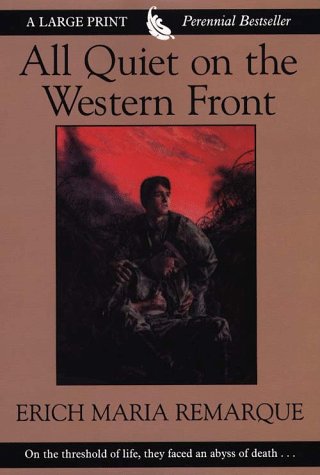
All Quiet on the Western Front (Thorndike Press Large Print Perennial Bestsellers Series)


Available at Amazon Check Price Now!


All Quiet on the Western Front (Thorndike Press Large Print Perennial Bestsellers Series)


   Customer Rating :


   Availibility : N/A


All Quiet on the Western Front (Thorndike Press Large Print Perennial Bestsellers Series) RelateItems


All Quiet on the Western Front (Thorndike Press Large Print Perennial Bestsellers Series) CustomerReview


"All Quiet on the Western Front" remains the quintessential anti-war novel. The events depicted in the novel occurred almost a century ago. Remarque was a master, not only at depicting the horrors of trench warfare, which the First World War is most noted for, but also the power relations which accompany war, both within the military, and in society at large. His prose burns. Consider simply the issue of how new recruits are trained: "We became soldiers with eagerness and enthusiasm, but they have done everything to knock that out of us. After three weeks it was no longer incomprehensible to us that a braided postman should have more authority over us than had formerly our parents, our teachers, and the whole gamut of culture from Plato to Goethe...We had fancied our task would be different, only to find we were to be trained for heroism as though we were circus-ponies." Yes, "braided postman."

I first read this work over 40 years ago, before I entered the Army. It proved to be the best "orientation manual" possible for what the military would be like, despite the fact that Remarque depicted the German Army of World War I, and I was in the American Army in Vietnam. There were several passages that I remembered, and they proved to be astonishingly prescient. For example, the manner is which Kat died in the book, and Paul's utter surprise that he was actually dead from such a small wound reflected the first casualty I treated, a Lieutenant who was just so unlucky to have gotten hit where he did. But on this re-read, I was impressed with how many other portions were also relevant. Remarque brilliantly depicted the immense emotional dissonance that Paul experienced on leave, with his fellow citizens of the home front who were always so willing to pat him on the back, and buy him a beer, and then pontificate in their excruciatingly clueless manner about what was needed to "really win this war." And then there are the hospitals, as Remarque says: "A hospital alone shows what war is." The author depicts the suffering of the soldiers, and the sometimes callousness of the staff that could be drawn from the recent news articles on the scandals at Walter Reed Hospital. Remarque even includes the physicians, as he and I would both say, a very slender minority, but nonetheless real, who see the war and their "captive audience" as a wonderful laboratory to experiment - in this book's case it was a surgeon who loved to break feet, in an always failing attempt to cure "flat feet."

War can make a liar out of you. Paul Baumer is home on leave. He knows the agonizing way that Kemmerich died. He has to see his mother, who wants to hear the entire, honest truth. There is no way he can tell her; there is no way that he can say your son died for nothing at all. He has to say: Your son died a hero, and he died instantly. As to the truth: "I will never tell her, she can make mince-meat out of me first. I console her..." In another scene Paul is in a shell crater, a Frenchman also jumps in it, and Paul instinctively has to kill him. From his papers he learns that he is Gerald Duval, a printer. Paul realizes that he is just another poor slob who got caught up in the war, and didn't make it. In the crater, Paul makes a promise to him: "I promise you, comrade. It shall never happen again." As we all know, not only again, but again and again it continues to happen.

Remarque brilliantly depicts the nitty-gritty of war, from the lice to the rats. In his case, much time was spent scrounging for food, which was one of the real differences with the American Army in Vietnam. It might have bland, but the food was always adequate for us. But he is equally adept at addressing the larger issues of why wars occur, and in one scene, after they had been issued new clothes (which were later collected!) for the Kaiser's inspection, the infantrymen ask each other if he could have prevented the war. The conclusion was, no, not him alone, but if only 30 people, those with the power, had said no, there would have been no war. Remarque has an excellent passage, worthy of Pascal's ruminations questioning the right to kill a man because "he lives on the other side of the river." Remarque says: "A word of command has made these silent figures our enemies; a word of command might transform them into our friends. At some table a document is signed by some persons whom none of us knows, and then for years together that very crime on which formerly the world's condemnation and severest penalty fell, becomes our highest aim... Any non-commissioned officer is more of an enemy to a recruit, any schoolmaster to a pupil than they are to us."

This book should be a requirement before any student can graduate from high school. Even more so, it should be an essential curriculum item in any journalism school; the last two brief paragraphs explain the title to the book, and that aspiring journalist might hesitate in ever writing: "MACV reported that there was only light and scattered fighting in the Central Highlands." Or, on the Western Front, or in Helmand province.


*** Product Information and Prices Stored:Apr 04, 2010 08:40:23

Available at Amazon Check Price Now!

LG LCD HDTV